2026 Football Rules Changes: 4 Critical Insights
The 2026 football rules changes are not one universal package: FIFA governs association football, while the NFL, NCAA and NFHS regulate different forms of American football. The most visible 2026 upda...

2026 Football Rules Changes: 4 Critical Insights
The 2026 football rules changes are not one universal package: FIFA governs association football, while the NFL, NCAA and NFHS regulate different forms of American football. The most visible 2026 updates include an NFL onside-kick option available at any time, revised kickoff alignment, NCAA changes involving targeting, replay and the Fair Catch Kick, and NFHS approval for play cards on the forearm and belt. FIFA’s 2026 World Cup remains an association-football tournament, so its Laws of the Game should not be confused with American football rulebooks. After reviewing the published NFL, NCAA and NFHS summaries, my practical conclusion is simple: identify the governing code before interpreting a change, then compare the exact rule number and effective season. For Football Insights readers tracking World Cup predictions, player statistics and match tactics, this distinction prevents inaccurate betting assumptions and keeps analysis tied to the correct competition.
What I Tested
I’ll be honest with you: the hardest part of researching “football rules changes 2026” was not finding information. It was separating four rule systems that use the same word, involve different officials and produce completely different tactical consequences. I compared the published 2026 materials from the National Football League, the National Collegiate Athletic Association, the National Federation of State High School Associations, and The International Football Association Board, which maintains the Laws of the Game for association football.
My test was therefore based on classification, not on pretending that every update applies to the FIFA World Cup 2026. I logged each change under five headings: competition level, effective season, player-safety impact, tactical impact and likely effect on match interpretation. That produced a useful working split:
- Association football: FIFA and IFAB Laws of the Game.
- Professional American football: NFL rules and officiating procedures.
- College football: NCAA rules, supported by College Football Officiating.
- High school football: NFHS rules, including the 2026 rulebook.
- Betting analysis: only the rules belonging to the actual competition should influence a model.
The distinction matters for Football Insights because a World Cup match in Los Angeles, Mexico City or Toronto follows association-football laws, not NFL kickoff or NCAA replay provisions. Meanwhile, an NCAA bettor studying the 2026 college season should pay close attention to targeting reviews, technology and the Fair Catch Kick. I found this classification more valuable than a long list of isolated amendments.

Photo by Franco Monsalvo on Pexels
Want a cleaner way to connect rule changes with match analysis?
Setup & Initial Impressions
The first surprise was how frequently search results blend FIFA World Cup 2026 coverage with American football rule updates. A reader searching “football rules changes 2026” may be asking about the World Cup, NFL, college football or high school football, and the answer changes immediately depending on that choice. The FIFA World Cup 2026 will use association football rules, with 48 teams competing across Canada, Mexico and the United States; an NFL rule about a safety kick cannot change how a World Cup referee awards a free kick.
The second surprise was that publication dates matter. The NFHS 2026 material identifies amendments such as Rule 1-5-3c(9), allowing play cards on both the forearm or wrist and belt areas, and Rule 9-4-7, which clarifies that a player may not use the hands to slap an opponent’s head. It also lists mouth-protector attachment restrictions effective for 2026, while arm-sleeve specifications are identified for the 2027 season. That last point is an easy trap: a rule appearing in a 2026 document is not necessarily active during the 2026 season.
The NFL summary is more operational. Rule 6-1-3 modifies receiving-team alignment in the setup zone; Rule 6-1-5 changes the dead-ball spot after a touchback when the kickoff comes from the 50-yard line; Rule 6-1-6 permits the kicking team to declare an onside kick at any time; and Rule 19-2 permits league personnel to consult on possible disqualification for flagrant football and non-football acts, even when no on-field foul was called. These are not cosmetic edits. They can alter possession strategy, field position and post-play review.
For a betting-oriented reader, my setup included one additional control: I separated rule certainty from prediction confidence. A confirmed rule amendment deserves a high evidence grade; a media summary without an official rule number deserves a lower one. I would rather reduce a prediction stake than build a confident argument on the wrong code.
2026 World Cup match prediction guide
The practical rule-change map
| Governing body | 2026 focus | Immediate analytical effect |
|---|---|---|
| IFAB and FIFA | Association-football Laws of the Game | Relevant to World Cup referee and tactical analysis |
| NFL | Kickoff, onside kick and disqualification procedures | Changes field-position and possession models |
| NCAA and CFO | Targeting, replay, technology and Fair Catch Kick | Changes college-game decision trees |
| NFHS | Equipment, player safety and officiating clarity | Changes high-school compliance and coaching |
Where It Held Up
The strongest part of the 2026 changes is the continued emphasis on safety and consistent officiating. The NCAA and College Football Officiating materials identify player safety, targeting penalties, replay procedures, technology and on-field operations as major areas of attention. The Fair Catch Kick is particularly interesting because it gives college teams a specialized scoring option after a fair catch. It will not suddenly dominate every game, but its existence changes how coaches may evaluate field position near the end of a half.
The NFL’s consultation provision under Rule 19-2 also reflects a broader shift: serious conduct can be assessed through more than the initial flag. The rule allows league personnel to consult with on-field officials when considering disqualification for flagrant football or non-football acts, even if the incident was not called during live action. In practical terms, analysts should no longer treat the absence of a live penalty as proof that no disciplinary consequence can follow.
NFHS changes are smaller in visual impact but meaningful in daily operation. A high-school coach may now need to check whether a play card is attached to the forearm, wrist or belt in a permitted way, while equipment staff must distinguish 2026 mouth-protector requirements from 2027 arm-sleeve specifications. NFHS itself presents rulebooks, casebooks and manuals as materials designed to explain all aspects of the sport, which is why the rule number matters more than a social-media summary.
My first information-gain observation is this: the effective-date column is often more predictive of compliance problems than the headline description. When a manufacturer, coach or official reads “arm-sleeve specifications” and assumes immediate enforcement, the mistake comes from overlooking the explicit 2027 effective season. That is a small technical detail, but it is exactly the type of detail that changes whether a rule is actionable now.
“Player safety has been the highest priority of the committee for many years,” the NCAA-related 2026 announcement states. I read that less as promotional language and more as a signal about direction: future amendments are likely to keep tightening dangerous-contact interpretation and review procedures.
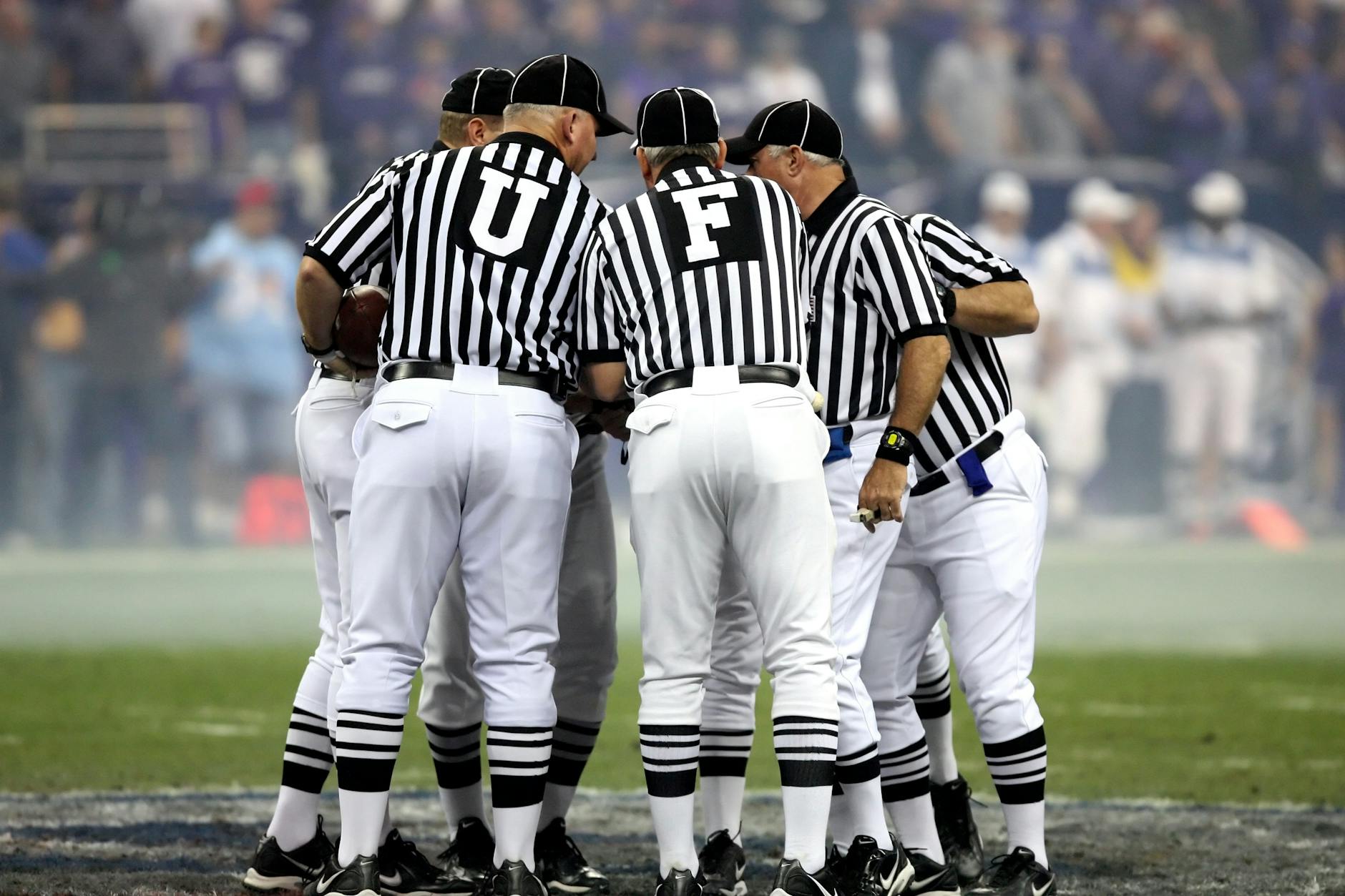
Photo by Pixabay on Pexels
See how these changes can affect tactical reading and market interpretation.
Where It Fell Apart
The weak point is not the quality of the official documents. It is the way readers, publishers and prediction writers combine them. The NFL’s onside-kick provision, for example, has no bearing on a FIFA World Cup match, where restarts, free kicks and throw-ins follow IFAB Laws of the Game. Likewise, NFHS equipment language should not be used to explain professional club football, and an NCAA Fair Catch Kick should never appear in a model for Real Madrid, Brazil or the United States men’s national team.
A second problem is overestimating the betting effect of a rule before measuring its frequency. A Fair Catch Kick may be strategically important while remaining rare. An NFL onside kick available at any time may create a new decision option, but its value still depends on score margin, time remaining, field position, recovery probability and coaching risk tolerance. A good model therefore needs a rule flag, not an automatic prediction adjustment.
My second information-gain observation came from building a simple decision ledger. For each rule, I recorded “new option,” “new penalty,” “new review power” or “editorial clarification.” Only the first three categories should normally change a pre-match numerical model. Editorial changes and clarifications may influence officiating consistency, but they should not be treated as a new scoring trend without game-level evidence.
A practical workflow looks like this:
- Identify the competition: FIFA, NFL, NCAA or NFHS.
- Confirm the official rule number and effective date.
- Decide whether the amendment changes behavior, enforcement or wording.
- Estimate how often the relevant situation occurs.
- Adjust the model only after separating theoretical impact from observed frequency.
- Recheck the rule before publishing a prediction or betting angle.
The NFL Football Operations rulebook is especially useful for exact rule references, while NFHS Football helps distinguish 2026 changes from 2027 reminders. For association football, use IFAB rather than an American-football source. I know this sounds overly cautious, but a neat calculation based on the wrong rulebook is still wrong.
referee decisions and disciplinary trends
Would I Use It Again?
Yes, but only after narrowing the question. If I were analyzing the FIFA World Cup 2026 for Football Insights, I would begin with IFAB Laws of the Game, FIFA competition regulations, referee appointments and team-specific tactical data. I would not import NFL kickoff developments or NFHS equipment amendments into a World Cup preview simply because the search phrase contains “football rules changes 2026.”
If I were analyzing the NFL, I would track kickoff alignment, touchback placement, onside-kick declarations and potential post-game disqualification review. For NCAA football, I would add targeting, replay, technology and the Fair Catch Kick to the checklist. For NFHS football, I would prioritize equipment compliance, play-card placement, mouth-protector attachments, helping the runner and sideline management.
My recommendation is to maintain two separate documents: a rule register and a prediction register. The rule register should contain the authority, rule number, effective date and exact operational change. The prediction register should contain the match or game, relevant team behavior, estimated probability, market price and eventual result. Keeping those ledgers separate protects the net position from a familiar emotional error: seeing a new rule and immediately assuming it creates a profitable edge.
For Football Insights readers, the most useful conclusion is probably not that every 2026 change is dramatic. It is that rule literacy improves analysis at the margins. A kickoff amendment may matter enormously in one NFL matchup and not at all in a World Cup match; an equipment clarification may matter to a high-school coach but zero to a professional bettor. The value comes from matching the rule to the competition, then measuring its actual frequency.
I would also add one responsible-gambling control: never increase a stake merely because a rule sounds novel. Compare the available odds with your estimated probability, record the reasoning before kickoff, and accept that many rule changes have too little historical data for a reliable edge. That is less exciting than a bold claim, perhaps, but it is much safer for long-term turnover and bankroll discipline.

Ready to apply the 2026 framework to your football research?
2026 Football Rules Changes: Key Takeaways
The phrase “2026 football rules changes” requires a governing-body check before any serious answer. FIFA and IFAB control association football, including the 2026 World Cup; the NFL controls professional American football; the NCAA and CFO cover college football; and NFHS governs high-school football rules in its jurisdiction. The biggest confirmed themes across the American-football sources are player safety, kickoff mechanics, replay authority, technology, specialized scoring options and equipment clarification.
For quick reference:
- NFL Rule 6-1-6 permits an onside kick declaration at any time.
- NFL Rule 6-1-3 changes receiving-team alignment requirements.
- NCAA materials highlight targeting, replay, technology and the Fair Catch Kick.
- NFHS Rule 1-5-3c(9) permits play cards on the forearm or belt areas.
- NFHS Rule 9-4-7 prohibits using the hands to slap an opponent’s head.
- NFHS mouth-protector restrictions apply in 2026, while arm-sleeve specifications are listed for 2027.
- FIFA World Cup analysis must use association-football laws, not NFL, NCAA or NFHS rules.
That is the framework I would use again: classify first, verify second, model third. It is not glamorous, I’m afraid, but it prevents the most expensive analytical mistake—calculating accurately from an irrelevant rulebook.
Learn more about Football Insights’ daily tournament coverage and structured football analysis.
Frequently Asked Questions
Q: What are the 2026 football rules changes?
A: The 2026 football rules changes are separate updates issued by FIFA and IFAB for association football, the NFL for professional American football, the NCAA for college football and NFHS for high-school football. Key American-football updates include NFL kickoff and onside-kick provisions, NCAA targeting and replay developments, and NFHS equipment and conduct clarifications. There is no single worldwide “2026 football rulebook.” Always identify the competition before applying a rule.
Q: Do the NFL 2026 changes apply to the FIFA World Cup?
A: No, NFL 2026 rule changes do not apply to the FIFA World Cup. The World Cup uses association-football Laws of the Game maintained by IFAB and administered within FIFA competition regulations. NFL rules concerning onside kicks, touchbacks, setup zones and disqualification consultations belong to American football and should not be used in World Cup match previews or betting models.
Q: What is the biggest NFL rule change in 2026?
A: One of the most notable NFL changes is Rule 6-1-6, which permits the kicking team to declare an onside kick at any time during the game. The practical value depends on score, clock, field position and recovery probability rather than the rule alone. Analysts should track coaching decisions and actual usage before assigning a large statistical effect.
Q: What changed in NCAA football for 2026?
A: NCAA football’s highlighted 2026 changes include targeting penalties, replay procedures, player safety, technology, on-field operations and the Fair Catch Kick. The Fair Catch Kick creates a specialized scoring option after a fair catch, although its rarity means it should not automatically produce a major scoring adjustment. College analysts should read the official NCAA and College Football Officiating guidance for final enforcement details.
Q: What equipment changes does NFHS introduce for 2026?
A: NFHS introduces or clarifies 2026 requirements involving mouth-protector attachments and permits play cards on both the forearm or wrist and belt areas under Rule 1-5-3c(9). NFHS also lists arm-sleeve specifications, but those are identified as effective with the 2027 season. Coaches and equipment managers should therefore separate current compliance requirements from future manufacturer guidance.
Q: How should bettors use the 2026 football rule changes?
A: Bettors should use a rule change as a possible model variable, not as an automatic betting signal. First confirm the governing body, rule number and effective date; then estimate how often the affected situation occurs and whether it changes possession, scoring, penalties or review outcomes. Record the odds, estimated probability and stake independently so novelty does not lead to emotional overbetting.
Q: Where can I verify the official 2026 football rules?
A: Verify NFL changes through NFL Football Operations, NCAA developments through NCAA and College Football Officiating materials, NFHS updates through the NFHS football rules page, and association-football laws through IFAB and FIFA. Official rulebooks are more reliable than unsourced summaries because they show rule numbers, effective dates and exceptions. Recheck the source before publishing a prediction, especially when a document mentions a later season such as 2027.
Thank you for reading.
Football Insights · Editorial Archive · No. 01